Travel to Singapore
Day 1 Arrival at Singapore
Singapore's history is closely linked to its strategic position at the southern tip of the Malay Peninsula. Although the island had earlier settlements, modern Singapore dates from 1819, when Sir Stamford Raffles established a British trading post on behalf of the British East India Company. The new port rapidly became one of the busiest in Southeast Asia because it operated as a free port, attracting merchants from China, India, the Malay Archipelago, and Europe. During the nineteenth century, Singapore became an essential stop on the maritime routes connecting Europe with East Asia, particularly after the opening of the Suez Canal in 1869. The island later formed part of the Straits Settlements, administered by Britain together with Penang and Malacca. During the Second World War, Singapore was occupied by Japan between 1942 and 1945, an event that deeply influenced its political development. After the war, British administration returned, but demands for self-government steadily increased. Singapore became fully independent in 1965, following a brief period within Malaysia, and began a rapid transformation based on industrialization, international trade, finance, and modern infrastructure. Today it is one of the world's leading financial centers and among the busiest ports on the planet.
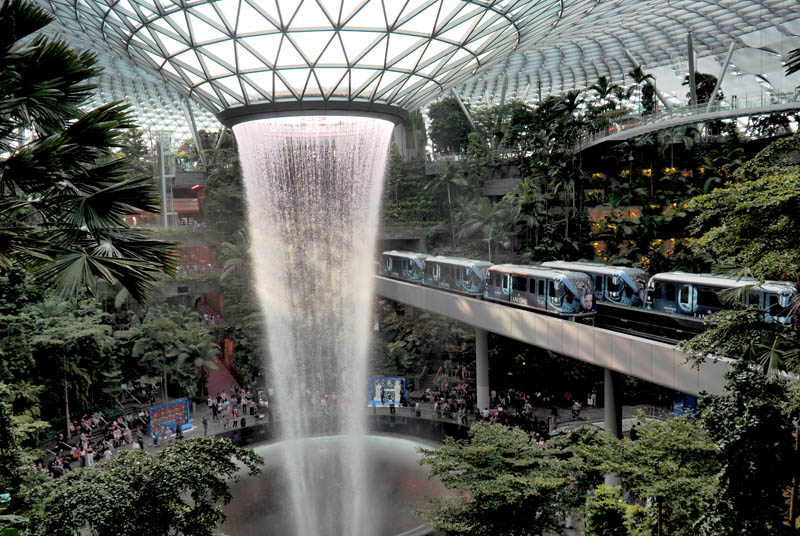
Changi airport - Jewel
The population of Singapore reflects the multicultural origins of the city-state. Chinese, Malay, Indian, and Eurasian communities have shaped its language, religion, architecture, and cuisine for generations. Four official languages—English, Mandarin Chinese, Malay, and Tamil—are used throughout the country, with English serving as the principal language of administration, business, and education. Urban planning has also played an important role in Singapore's development. Modern residential districts coexist with preserved historical neighborhoods such as Chinatown, Little India, and Kampong Glam, where many traditional buildings have been restored. The public transport system, particularly the Mass Rapid Transit (MRT) network, connects nearly every district efficiently, making it possible to travel across the island without relying on private vehicles. Strict urban regulations, extensive green spaces, and long-term planning have contributed to the city's reputation for cleanliness, safety, and efficient public services, while major developments such as Marina Bay symbolize Singapore's transformation into a global metropolis during the twenty-first century.
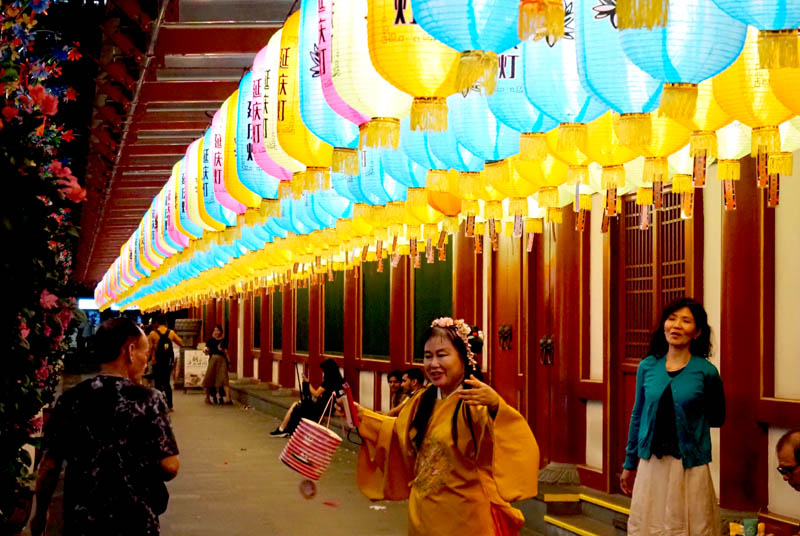
Singapore - Buddha Tooth Relic Temple
Our first contact with Singapore took place immediately after landing at Changi Airport, which is consistently ranked among the world's leading international airports. Before leaving the terminal, we visited the famous Jewel Changi Airport, a mixed-use complex built around the HSBC Rain Vortex, the world's tallest indoor waterfall, which descends through the center of a vast glass dome surrounded by indoor gardens. We also rode the Skytrain, the automated monorail connecting the airport terminals. The elevated track passes directly through Jewel, allowing passengers to enjoy close views of the waterfall and the surrounding Forest Valley before continuing between terminals. Once we had explored this area, we followed the clearly marked signs to the MRT station. Using Singapore's integrated metro system, we travelled from the airport to Chinatown Station, where our accommodation was located on Pagoda Street, one of the neighborhood's best-known pedestrian streets lined with restored shophouses.
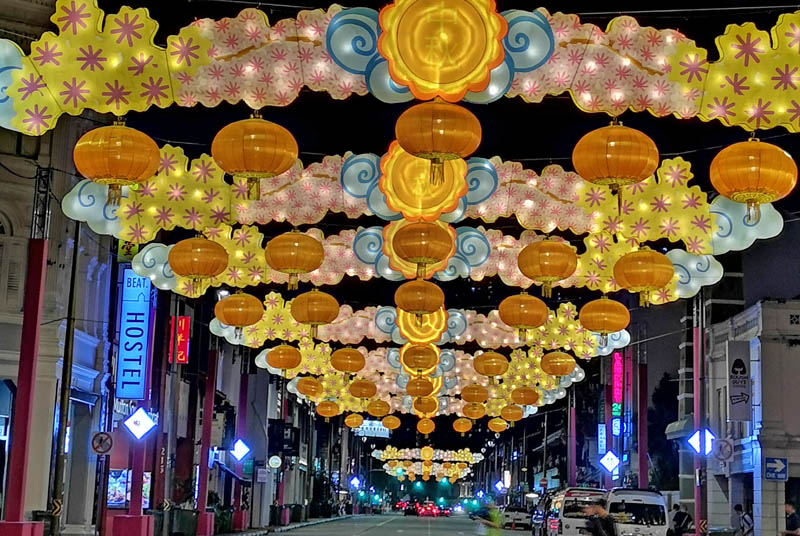
Singapore - Chinatown at Mid-Autumn Festival
After checking into our accommodation and leaving our luggage, we began our first evening walk through Chinatown. This district developed during the nineteenth century as the center of Singapore's Chinese community and still preserves many traditional buildings, temples, and commercial streets. Because our visit coincided with the Mid-Autumn Festival, the neighborhood was decorated with hundreds of illuminated lanterns suspended above the streets. Our main stop was the exterior of the Buddha Tooth Relic Temple, one of Singapore's most important Buddhist temples. Completed in 2007, the temple was designed in the architectural style of the Tang Dynasty and houses what is believed to be a sacred relic of the Buddha inside a richly decorated stupa on its upper floors. Although we did not enter the building that evening, we walked around the square to observe its illuminated façade together with the festival decorations that filled the surrounding streets. The nearby food stalls and restaurants were particularly busy, reflecting Chinatown's role as one of Singapore's principal dining districts.
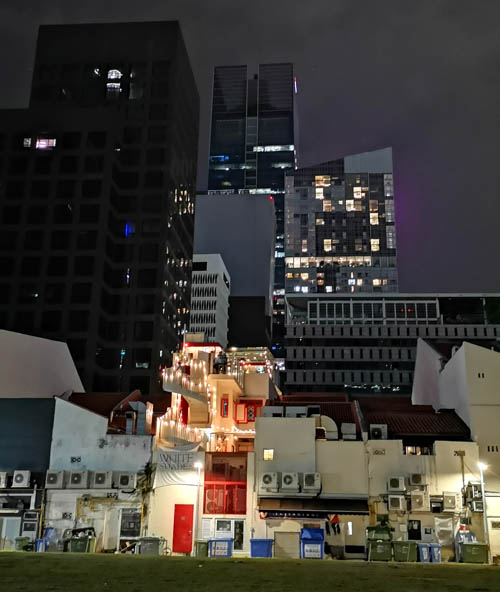
Singapore - Downtown (Cross St)
After dinner, we walked toward Downtown Singapore to experience the city skyline after dark. We walked along the waterfront promenade overlooking the financial district. From this location, the skyline is dominated by modern office towers that form Singapore's central business district, while the bay itself is bordered by public walkways, viewing platforms, and landscaped areas. The most recognizable landmark is the Marina Bay Sands hotel, consisting of three towers connected at the top by the SkyPark, a structure that extends beyond the buildings to create one of the world's largest rooftop observation areas. Nearby are several other major developments, including the ArtScience Museum, whose lotus-inspired design stands beside the bay, and the Helix Bridge, a pedestrian bridge whose structure was inspired by the shape of human DNA. The lighting of the buildings reflects across the water, creating the characteristic nighttime panorama associated with Marina Bay.
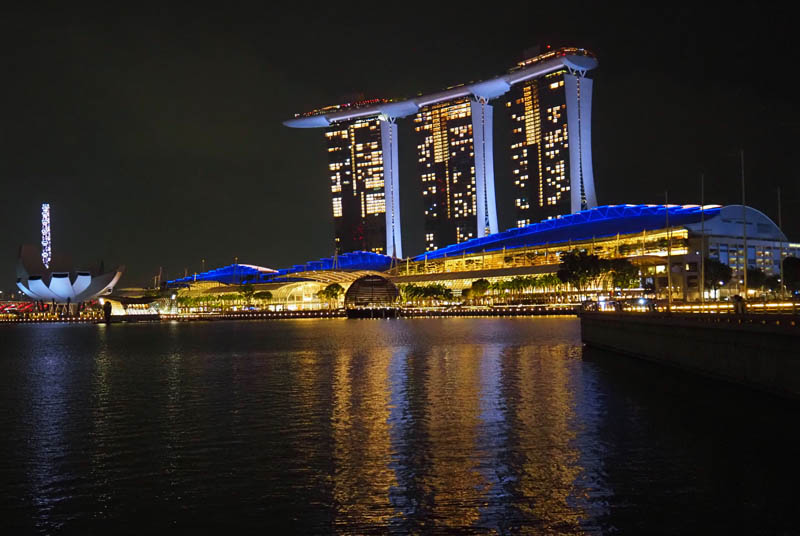
Marina Bay Sands hotel
We concluded our first day with a leisurely walk along the waterfront before returning to Chinatown. The route around Marina Bay allowed us to observe how the different districts are connected by pedestrian promenades, bridges, and efficient public transport. Information panels along the waterfront explain the history of the bay, which was significantly enlarged through land reclamation projects during the late twentieth century as Singapore expanded beyond its original coastline. From several viewpoints we could also identify landmarks that would become part of our itinerary over the following days, including the Singapore Flyer, the Gardens by the Bay, and the Merlion. After returning to Pagoda Street, we ended our first day in Singapore, having combined our arrival, the exploration of Changi Airport, an introduction to Chinatown during the Mid-Autumn Festival, and our first views of the city's modern skyline.